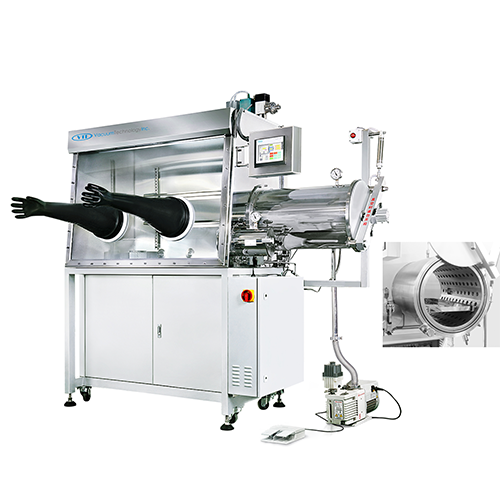
In high-precision experimental fields such as materials science, lithium battery research and development, semiconductor technology and fine chemical synthesis, high-purity inert gas glove boxes are the core infrastructure to provide a water-free and oxygen-free ultra-clean environment. In order to strictly control the water and oxygen content in the cabin at extremely low ideal levels, the equipment not only needs to rely on an efficient gas purification system for continuous circulation, but also requires experimenters to establish strict specifications for items entering and placed in the glove box cabin. Without refined management, items entering the cabin can easily become "invisible killers" that destroy trace amounts of water and oxygen balance.
The glove box's main compartment maintains a completely closed-loop clean environment; all external items must pass through the transition chamber for safe transfer. However, in practice, the physical properties of the materials themselves are often overlooked:
1. Utilizing Chambers in a Different Size: High-performance glove boxes are typically equipped with two sizes of transition chambers. Smaller samples, tools, or spare parts should be strictly prioritized for use in the manually controlled smaller transition chamber. This significantly reduces the gas replacement volume, saving expensive inert gas and minimizing disturbance to the main chamber's pressure.
2. Completely Eliminating "Dead Volume": Items entering the large transition chamber must undergo a rigorous "vacuum-filling" cycle. A common mistake many operators make is placing unopened sealed reagent bottles, tightly capped sample tubes, or devices with hollow internal structures directly into the transition chamber. The residual air trapped inside these objects cannot escape during vacuuming; once introduced into the main chamber and opened, the water and oxygen levels in the main chamber will spike instantly. Therefore, before such items enter the transition chamber, the bottle cap or lid must be loosened and opened to ensure that the internal air can be completely removed during the filtration stage.
Although the integrated fan in the glove box has a large circulation flow rate, the capacity of the copper catalyst and molecular sieve packed in the purification column is limited.
1. High-Moisture Materials Must Be Pre-dried: Ordinary wiping paper, ordinary cotton swabs, certain highly hygroscopic porous powders, and fibrous materials must not be directly introduced into the box before treatment. These seemingly dry items absorb a large amount of trace amounts of moisture from the environment at room temperature and pressure, which will cause a rapid rise in dew point when brought into the box. These items must be pre-dried at high temperature in an external vacuum drying oven before entering the box.
2. Strict Control of Highly Volatile Organic Solvents: When conducting chemical synthesis or preparing battery electrolytes in the glove box, contact with various organic solvents is inevitable. It must be emphasized that large quantities of unsealed volatile solvents must not be left open in the box for extended periods. These solvent vapors, once introduced into the purification column by the circulating airflow, can easily damage the molecular sieve structure or cause catalyst poisoning and failure, significantly shortening the regeneration cycle of the purification materials. After use within the chamber, all solvents must be immediately capped and tightened, and stored in the designated area on the stainless steel shelf.
Although the main body of the glove box is constructed of approximately 3mm thick 304 stainless steel and approximately 8mm thick tempered safety glass, providing a robust structure, the operating interface for laboratory personnel relies entirely on 0.4mm thick butyl rubber gloves. This thin barrier dictates the handling of items within the chamber:
1. Physical Isolation of Sharp Tools: Sharp objects such as scissors, scalpels, tweezers, metal sheets, or syringe needles used within the chamber must be covered with protective covers or neatly placed on multi-tiered shelves when not in use. Scattering is strictly prohibited. Accidental punctures during operation can instantly cause a large influx of outside air, rendering experimental samples unusable, and potentially causing personal injury to the operator.
2. Precise Sealing of Corrosive Chemicals: Although the inner surface of the 304 stainless steel is typically treated with an oil-film brushed finish to enhance corrosion resistance, there is still a risk of corrosion and rust when exposed to strong acids, strong alkalis, or highly volatile halogens. These chemicals must be stored in corrosion-resistant Teflon containers. Furthermore, because the compartment is equipped with spare interfaces for expanded functionality, excessively high concentrations of acidic or alkaline gases can easily corrode the metal sealing rings of the interface flanges, leading to minor leaks. Therefore, the amount of corrosive materials used must be precisely controlled, and sealing must be performed immediately after use.
Standard glove box systems use intelligent PLCs and foot switches to strictly control the working pressure within a slightly positive or negative range. The system is highly sensitive; exceeding +/- 16 mbar will trigger the equipment's self-protection program.
1. Preventing Sudden Pressure Changes: Using pressurized gas sources within the chamber, conducting chemical reactions that generate significant heat or large amounts of gas, or moving large, irregularly shaped objects at extremely high speeds can cause drastic fluctuations in local or overall pressure within the chamber. Operations should be gentle, and reactions involving gas generation must be equipped with pressure stabilization or absorption devices to prevent alarm triggering and automatic valve closure.
2. Maintaining Unobstructed Gas Filters: Glove boxes typically have 0.3 μm high-efficiency particulate filters at the gas inlet and outlet to maintain a high standard of cleanliness within the chamber. When arranging items and shelves within the chamber, these two gas inlets must be avoided. Do not place reagent kits, equipment, instruments, or miscellaneous items in front of the filter to block airflow, otherwise it will cause gas dead zones in the chamber, resulting in localized accumulation and increased water and oxygen content, affecting the parallelism of the overall experiment.
The ultra-clean, inert environment of a glove box is so highly regarded in the industry that it's said to be "30% equipment, 70% management." From understanding the limit of <1ppm, to standardizing the evacuation and degassing operations of the large/small transition chambers, and to meticulously managing the pressure of butyl gloves and the chamber itself, every step of the rigorous treatment of the items inside the chamber is the cornerstone for ensuring the accuracy of research data, extending the lifespan of the gas purification system, and guaranteeing laboratory safety.

 EN
EN



